-
Careers • News • Contact us •
- Login
- Français


Creating new
knowledge
Exploring new avenues to develop tomorrow’s medical knowledge through an approach that integrates basic and clinical research
Our research units are led by principal investigators who collaborate in a spirit of collegiality and with the vision of bridging the gap between research and patients. They train the next generation of scientists and are independent and creative minds who work tirelessly to improve health.
Current research
"We aim to uncover which omega-3 fatty acid best reduces risk factors for type 2 diabetes in people with high plasma apoB"
May Faraj, research director
Current research
About 1 in 9 Canadians were living with diabetes in 2024, mostly type 2 diabetes (T2D) and an additional 3 in 10 were undiagnosed or were at high-risk for developing diabetes. Diabetes confers an equal risk to ageing 15 years and is a leading cause of death and disability worldwide.
Fortunately, type 2 diabetes is preventable.
Elevated blood apoB, measuring high number of particles that carry “bad cholesterol” called LDL, increases the risk of cardiovascular disease especially in people with obesity. Our work over the past 18 years, confirmed by large population studies, show that high blood apoB may also promote the development of T2D by inducing the inflammation and dysfunction of fat tissue in humans.
Our findings also show that combined marine omega-3 fatty acids, EPA and DHA, improve risk factors for T2D particularly in people with high blood apoB. However, EPA and DHA do not appear to provide similar benefits.
Thus, our current focus is to uncover which type of omega-3, EPA or DHA, best treat T2D risk factors in people with high blood apoB. EPA or DHA can then be used as an accessible and tailored therapy to help prevent T2D in this high-risk population.
To do so, we initiated in Oct 2026 a phase II randomized controlled trial (RCT) to compare for the first time the effects of EPA versus DHA on T2D risk factors in adults with overweight or obesity and high blood apoB. Using a unique combination of clinical and fundamental testing, we will evaluate the change in metabolic and inflammatory anomalies in our research participants in response to 12-week supplementation with EPA, DHA or placebo (corn oil). About 50% of Canadians have the blood apoB level targeted in this study.
This clinical trial received funding from Diabetes Canada and was approved by Health Canada. It is registered online at: https://clinicaltrials.gov/study/NCT07575438.
| Team |
|
| Affiliations |
Other affiliations
|
| Degrees and experience |
|
| Publications |
Bedside-to-bench translational research in cardiometabolic disease
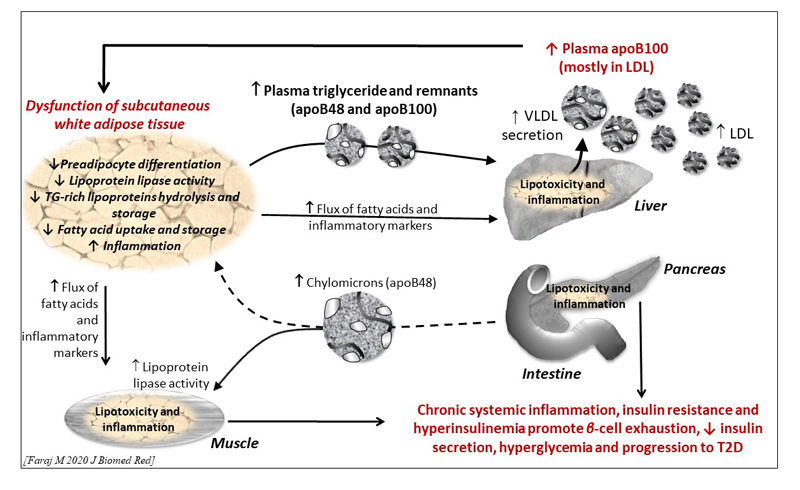
Our expertise in clinical and fundamental techniques in cardiometabolic disease allows us to dissect a problem observed in humans by studying it on a tissue, cell, and molecular level. To date, we have focused on a novel hypothesis initiated in our lab in 2009 linking apoB-lipoproteins, mostly LDL, to the promotion of type 2 diabetes in humans. To do so, we completed two clinical trials with fundamental studies examining the cross-talk between the intestine, liver, muscle, pancreas, white adipose tissue and circulation, which are major sites controlling metabolism in humans.
Important Discoveries
|
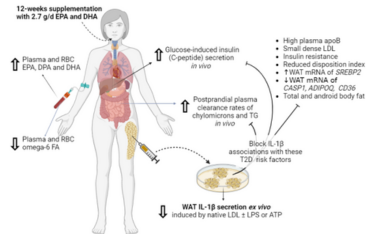
2024 EPA and DHA inhibit LDL-induced upregulation of human adipose tissue NLRP3 inflammasome/IL-1β pathway and its association with diabetes risk factors |
|
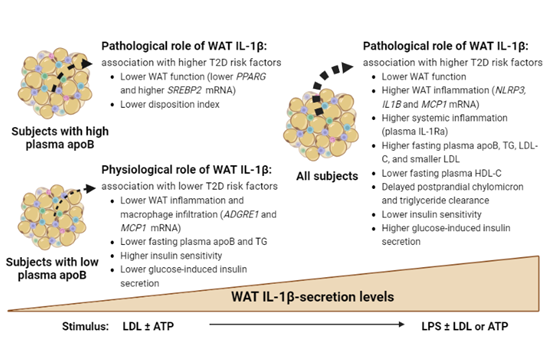
2023 Native low-density lipoproteins are priming signals of the NLRP3 inflammasome/interleukin-1β pathway in human adipose tissue and macrophages | Scientific Reports (nature.com) |
|
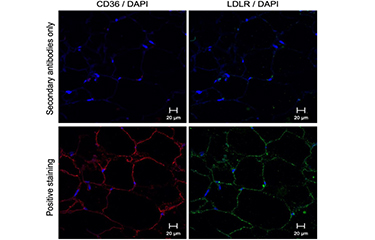
2021 Human white adipose-tissue surface expression of LDLR and CD36 is related to the activation of the NLRP3 inflammasome and risk factors for type 2 diabetes |
|
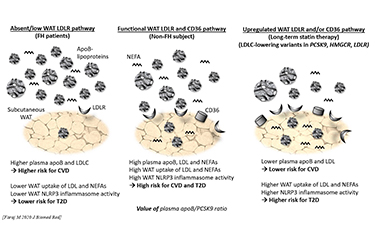
2020 Proposed model for why the risks for cardiovascular disease and type 2 diabetes can be additive or contradictory in humans |
|
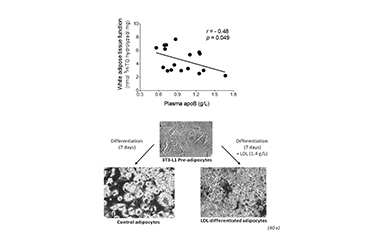
2013 Chronic and acute inhibitory effects of LDL on human white adipose tissue function |
Tools
| Press review |
|
| Grants |
01/2026- 12/2028 - Diabetes Canada - « End Diabetes Award » Amount: $450,000 Title: Role of EPA and DHA as tailored therapy for people living with obesity and high-risk for Type 2 Diabetes (END-T2D): a randomized-controlled trial (NCT07575438) Co-investigators: Rémi Rabasa-Lhoret (IRCM), Jean-Claude Tardif (Montréal Heart Institute), Marie-Claude Guertin (Montréal Heart Institute- Seriant)
06/2025 – 05/2029- Canadian Institutes of Health Research (CIHR)- Canadian Consortium on Neurodegeneration in Aging (CCNA) Phase III: Research Teams Amount: $1,058,080 Title: Effects of GLP1 agonist-induced weight loss on cerebral and blood markers of neurodegeneration in individuals with obesity and genetic risk for Alzheimer’s disease. Principle investigator: Alain Dagher (McGill University) Co-investigators: May Faraj (Université de Montréal/ IRCM); Claudine Gauthier (Concordia University); Xiao Wen Hu (McGill University); Filip Morys (McGill University); Ian Patton (Obesity Canada); Maria Rajah (Toronto Metropolitan University); Dana Small (McGill University); Christine Tardif (McGill University); Sylvia Villeneuve (Douglas Institut Universitaire en Santé Mentale); Yashar Zeighami (Douglas Institut Universitaire en Santé Mentale)
04/2025 - 03/2030- Canadian Institutes of Health Research (CIHR) - Operating grant Amount: $1,346,400 Title: Effects of GLP1-agonist induced weight loss on brain, metabolic, and cerebrovascular health measures. Principle investigator: Alain Dagher (McGill University) Co-investigators: May Faraj (Université de Montréal/ IRCM); Bratislav Misic (McGill University); Christine Tardif (McGill University); Claudine Gauthier (Concordia University); Dana Small (McGill University); Filip Morys (McGill University); Ian Patton (Obesity Canada); Michael Tsoukas (McGill University); Stephanie Fulton (Université de Montréal); Xiao Wen Hu (McGill University); Yashar Zeighami (Douglas Institut Universitaire en Santé Mentale)
06/2024 - 05/2025 - Département de nutrition, Université de Montréal Amount: $ 30,000 Title : Nouveau rôle de l'EPA et du DHA dans la régulation de la signalisation de TREM2 dans le tissu adipeux humain
02/2020 - Fondation J.A. DeSève Amount: $ 125,000 Title: LDL receptors and the risk for type 2 diabetes
4/2019 -03/2025 Canadian Institutes of Health Research (CIHR) Amount: $ 738,225 Title: White adipose tissue LDL receptors and omega-3 as modulators of the risk for type 2 diabetes (NCT04485871) Co-investigator: Maya Saleh (McGill University) |
| Recognitions and honors |
|
Join the
group Research
Available positions
Research Partners








Life in the
laboratory


110, ave des Pins West,
Montréal (Québec) Canada
H2W 1R7
514 987-5500


Partners

Research
Platforms
Student life
Admissions
The Institure
- A word from the president
- Our impact
- Our Legacy
- Governance
- Management Committee
- IRCM Awards
- Annual reports
Events
The Clinic
© Montreal Clinical Research Institute, Année.All rights reserves. | Privacy policy | Terms of use | Web site by Agence Riposte